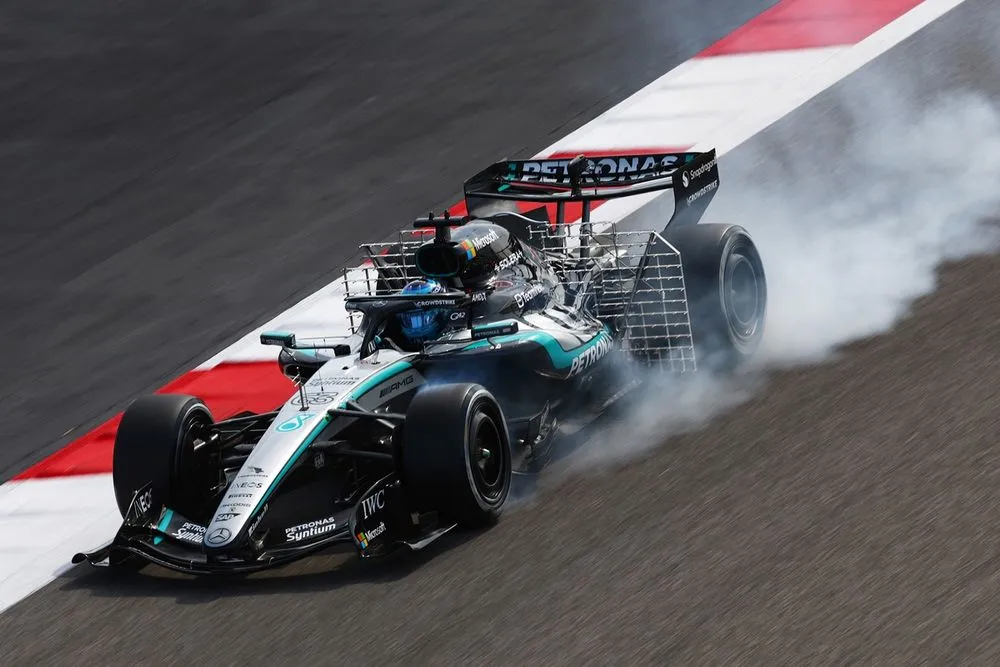



As winter testing kicked off in Bahrain, the Formula 1 paddock buzzed with discussions centered around a crucial term: compression ratio. Competitors are closely monitoring the Mercedes power unit, which adheres to the 16:1 limit during static evaluations but has the capability to achieve a higher ratio while in action on the track.
In response, Audi, Ferrari, and Honda jointly reached out to the FIA for clarification, while Red Bull‘s stance appears to be more intricate than previously assumed. The decision now lies with the FIA to determine whether it will modify the measurement protocols and, if so, the timeline for such changes.
A preliminary step in this process would involve securing a supermajority in the Power Unit Advisory Committee, requiring agreement from four of the five engine manufacturers, in addition to the FIA and FOM.
However, Vowles firmly expressed that he believes any intervention would contradict the very essence of Formula 1. “My strict perspective is that our power unit is entirely in line with the regulations. It has taken years of effort to develop the power unit to this standard. As a sport, we need to ensure that we do not turn this into a balance of performance series. This is a meritocracy, where superior engineering should be rewarded rather than penalized,” Vowles stated during a media interaction.
He continued, “I’m certain that other teams are upset. They haven’t been able to replicate what Mercedes has achieved, but we must proceed with caution. At this moment, I doubt anyone in the pit lane can definitively tell you which power unit is the best; we are fixated on just one aspect of it.”
Vowles reiterated his commitment to having a Mercedes power unit in Williams cars, attributing this decision to Mercedes’s expertise in navigating regulatory changes. “Having been with Mercedes for 23 years, almost from the beginning of my career, I have consistently been part of this journey. The day I joined this team, I renewed our partnership with Mercedes for a reason — they excel at interpreting regulations accurately and pushing the engineering boundaries. That is precisely what the power unit signifies for Mercedes today.”
Vowles pointed out that revising the measurement protocols is not as straightforward as it may seem. “First, they must develop a regulation, and good luck with that, which tests power units under conditions that mirror track performance. Anyone knowledgeable about compression ratios would agree that testing should ideally occur in ambient conditions.”
He added, “While they could potentially devise a testing method, there are additional considerations. Firstly, will we remain compliant with any future regulatory changes? The answer to that is quite uncertain. Secondly, what happens if the rules are modified? This could lead to eight cars being rendered non-compliant and absent from the grid. This is what I mean when I say we, as a sport, need to carefully consider the implications of any such changes.”
In defense of the FIA, the Williams team principal acknowledged the daunting task the governing body faces, especially at the onset of a new regulatory cycle. “To defend the FIA, it’s a challenging position. You have teams composed of numerous individuals brainstorming how to cleverly interpret the rules. Let’s be honest; that’s the nature of competition, and that’s what makes our sport exciting. The FIA has a tough job balancing the clever interpretations and allowing the sport to progress.”
He concluded, “Generally, the FIA does a commendable job finding the line between smart rule interpretation and overstepping. What I am highlighting is that we must ensure that decisions are not merely politically motivated by teams that failed to innovate, and the FIA must take appropriate actions based on a fair assessment of the situation.”