

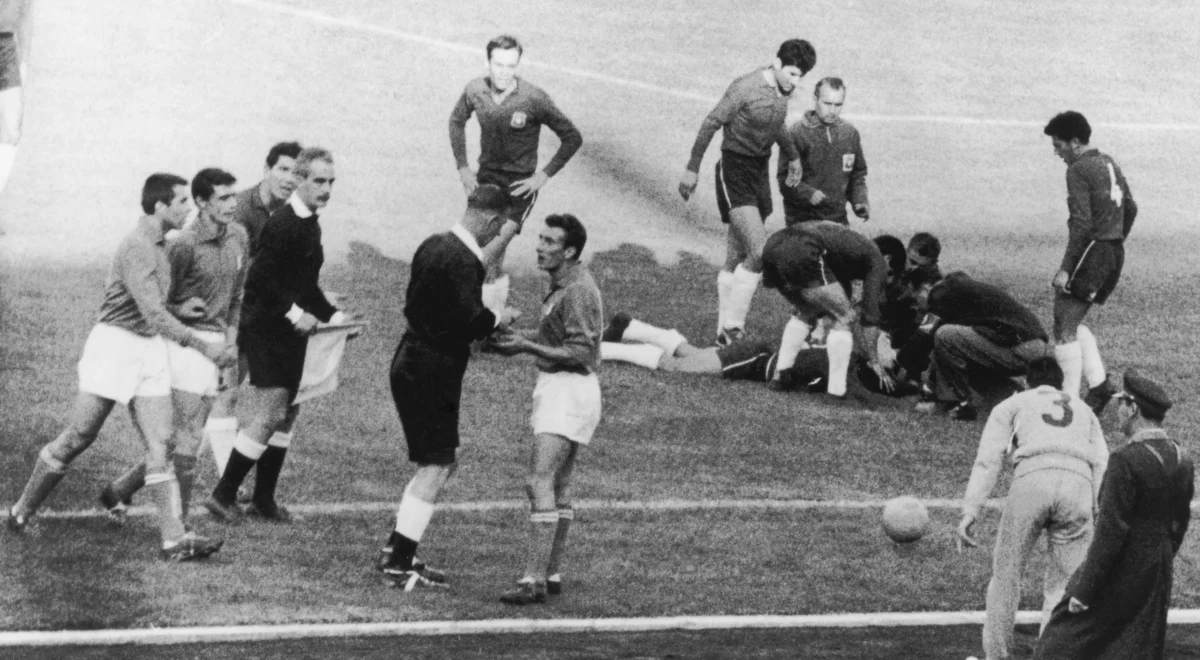
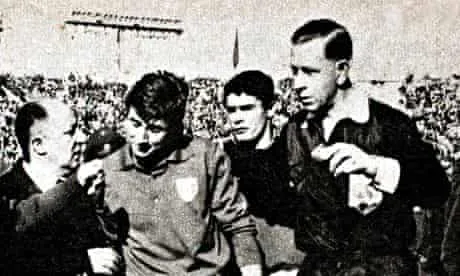
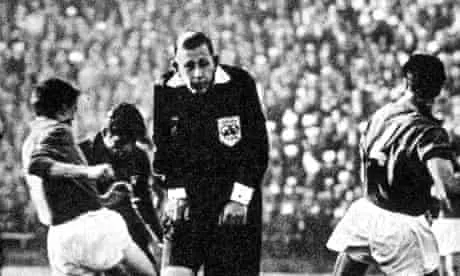
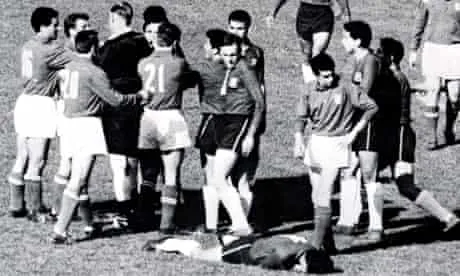
The match known as the Battle of Santiago has become legendary, its highlights taking two days to reach British television from South America. During this time, the game developed a reputation for its brutality, captivating those intrigued by the darker side of football. Frank McGhee noted in the Mirror, “The match is universally agreed by observers as the ugliest, most vicious and disgraceful in soccer history,”
David Coleman’s introduction to the BBC broadcast has gone down in history as iconic. “If you think that is exaggerating, watch the film on TV. But send the kids to bed first – it deserves a horror certificate!” he stated. “The game you are about to see is the most stupid, appalling, disgusting and disgraceful exhibition of football in the history of the game. This is the first time these countries have met; we hope it will be the last. The national motto of Chile reads, By Reason or By Force. Today, the Chileans weren’t prepared to be reasonable, the Italians only used force, and the result was a disaster for the World Cup. If the World Cup is going to survive in its present form something has got to be done about teams that play like this. Indeed, after seeing the film tonight, you at home may well think that teams that play in this manner ought to be expelled immediately from the competition.”
Despite its infamy, the Battle of Santiago was not an isolated event but part of a tournament marked by violence. Prior to the match, the Chilean newspaper Clarin described the tournament as resembling a World War. The Express echoed this sentiment, declaring, “The tournament shows every sign of developing into a violent bloodbath,” Reports depicted matches as battlefront dispatches, with players more focused on inflicting harm than playing football.
The first two days of the tournament featured eight games that resulted in four red cards, three broken legs, a fractured ankle, and cracked ribs. The opening match in England’s group saw Argentina defeat Bulgaria amid accusations of “Reports read like battlefront despatches. Italy v Germany was described as ‘wrestling and warfare” After receiving 69 free-kicks, Bulgarian player Todor Diev remarked that Argentina played “hacking, tripping, pushing and any other dirty tricks”
In another match, Eduard Dubinski of Russia suffered a broken leg due to a challenge from Muhamed Mujic of Yugoslavia. Though Mujic was not sent off, his federation was so appalled that they suspended him for a year. The Express criticized FIFA for inaction, stating, “It is lamentable that Fifa are not equally honest,”
Donald Saunders of the Telegraph observed, “They have ignored their own ruling that any offenders be dealt with immediately after the offence. With no action against the few out-and-out villains the ugly situation has been encouraged to spread.” Italy faced mounting pressure in their next match against the host nation, while Chile’s fervent support surged after derogatory articles about their country appeared in the Italian press.
In light of potential violence, FIFA appointed English referee Ken Aston, despite the Italian FA’s complaints about his previous officiating of a Chile match. The Italians, however, were not enthused, having exhausted their options.
From the outset, the match descended into chaos as Chilean players provoked the Italians, leading to a series of retaliatory actions that resulted in punishments for the Italians. The initial foul was called just 12 seconds into the game, and a sending-off occurred within four minutes. Giorgio Ferrini, the Italian player involved, resisted leaving the field, causing a 10-minute delay as armed police escorted him off. The Mirror reported, “It became clear after only two days that most teams were so anxious to avoid an early return home that they had forgotten football was only a game, and the World Cup its greatest shop window,”
Highlights included Leonel Sánchez breaking the nose of Italy’s captain, Humberto Maschio, with a left hook, while Mario David was sent off for retaliating. To compound the situation, Sánchez took the free-kick from which Jaime Ramírez scored, giving Chile a lead against nine Italian players.
Aston later commented on Sánchez’s punch, stating, “From all four centres came reports of violence, ill temper, serious injury, and precious little of the artistic soccer to be expected of the world’s leading professionals.” Aston was faced with challenges as he officiated alongside assistants who lacked experience. “the patriotism here for the national team is astonishing” he reflected. “the phones don’t work, taxis are as rare as faithful husbands, a cable to Europe costs an arm and a leg and a letter takes five days to turn up”
Years later, David asserted, “malnutrition, illiteracy, alcoholism and poverty” He recounted how Sánchez was allowed to remain on the field despite his actions, while others faced expulsions for less serious offenses. “Entire neighbourhoods are given over to open prostitution.”
Jimmy Hill wrote in the Observer about the confusion surrounding Sánchez’s actions, stating, “The pitch quickly became a battlefield as players forgot the ball and concentrated on kicking the nearest opponent,” He critiqued the officials for their failure to control the match, attributing much of the blame to their poor decisions.
Aston expressed his commitment to managing the situation, saying, “I had my back to the incident at the time,” He contemplated abandoning the match but felt responsible for the players’ safety. “If the referee or linesman sees nothing, nothing can be done. I’m sure the linesman did see it, but he refused to tell me.”
As tensions escalated, Italians found themselves ostracized in Chile, facing bans from public places. Jorge Pica of the Chilean FA alleged that Italians were “I was stuck with a Mexican and a little American,” claiming they aimed to injure Chilean players. The Italians retaliated by submitting a formal complaint against Aston, branding the Chileans as “They weren’t very good, so it became almost me against the 22 players.”
Criticism of Aston’s officiating was particularly intense in Italy, with David recalling a journalist labeling him “We weren’t throwing the punches, we were taking them. We Italians were the victims, not the aggressors,” Aston defended his actions, insisting, “Sánchez broke Maschio’s nose and the referee said nothing, but instead sent off Ferrini who was trying to take revenge on Sánchez but didn’t even touch him. Then their goalkeeper passed the ball to Sánchez, who sat on it and held it between his legs. In order to kick the ball I had to kick him a little bit too, and when he got up he punched me, but the referee pretended nothing had happened. Then I challenged Sánchez with an outstretched leg and caught him in the shoulder, and the shameless Aston sent me off too. I stood at the entrance to the tunnel to watch the rest of the game, and I can assure you that even with nine men we fought to the end.”
As violence persisted throughout the tournament, Aston and fellow referee Bob Davidson approached FIFA president Sir Stanley Rous to discuss the need for stricter measures. Davidson noted that referees had traveled far to officiate matches of a certain standard. “The Italians could not understand – and neither can I – why Sánchez had been allowed to remain on the field despite a passable imitation of Rocky Marciano, when one of their number had been banished for a less serious and far less obvious offence,” the Mirror reported.
Despite Rous’s assurances, FIFA’s response proved inadequate, with Ferrini receiving only a one-match suspension while David and Sánchez faced no serious consequences. At a meeting with representatives from all 16 teams, Rous emphasized the importance of sportsmanship, stating, “From that moment the last semblance of control left both players and officials. It was an appalling decision to allow a player to remain on the field after such a blatant disregard for the laws. The players will have to shoulder most of the blame, but the officials must face up to their responsibility for making this grotesque decision.”
However, FIFA’s crackdown was seen as insufficient. In subsequent tournaments, incidents continued, with brutal play persisting. The semi-final between Czechoslovakia and Yugoslavia saw the referee issuing warnings for rough play. In the other semi-final, Brazil’s Garrincha was sent off after being struck by objects thrown from the crowd.
The Brazilian FA faced challenges regarding Garrincha’s availability for the final, as the referee received pressure to downplay testimony regarding Garrincha’s actions. The situation culminated in a dramatic series of events leading to a lack of evidence against Garrincha, who played a pivotal role in Brazil’s victory. As the tournament concluded, the legacy of the Battle of Santiago remained a cautionary tale of violence in football.
The Observer’s Perspective on the Match
By Jimmy Hill, the Coventry City manager, 10 June 1962
Some argue that Ken Aston deserves recognition for his attempts to restore order during the Battle of Santiago, while others advocate for permanent bans for the nations involved. Can we, living 9,000 miles away and informed by television, provide a rational perspective on the week’s events?
The match displayed enough roughness to shock even the most seasoned observers. Players frequently threw punches, and chaos reigned on the pitch. While the lack of sportsmanship was evident, it should not tarnish the reputation of football.
In fact, English players were previously criticized for being “I expected a difficult match, but not an impossible one,” to succeed in international competition. What was once seen as a flaw is now viewed as a strength in the wake of this brutal display.
Given the immense pressure on players and officials to perform at the national level, it’s understandable that some may adopt a “I just had to do the best I could. It did cross my mind to abandon the match, but I couldn’t be responsible for the safety of the Italian players if I did. I thought that then and I still think it now. I tell you one thing: I didn’t add on any stoppage time.” mentality.
Football is inherently a physical game that requires skill and artistry. While clashes are part of the sport, the tactics employed should never resort to violence.
The Italians began the match aggressively but quickly lost their composure. No professional player, regardless of nationality, abandons fair play without provocation. With their tournament hopes at stake, the Italians seemed to lose sight of the game’s spirit. David’s actions in response to Sánchez’s provocations were emblematic of this loss of control.
From that moment on, both players and officials lost all semblance of order. Allowing Sánchez to remain on the field after such blatant disregard for the rules was a grievous error. The players bear the brunt of the blame, but officials must also accept responsibility for their decisions.
While Aston displayed commendable restraint, one must wonder whether such dedication was warranted under these circumstances. His courage is undeniable, yet a more balanced approach could have been beneficial.
Effective officiating often involves clear communication. When players and referees do not share a language, this communication can falter. The whistle becomes the sole means of conveying authority.
It may soon be necessary to consider the use of video evidence in addressing incidents like these, akin to practices in other sports. If the camera can make it harder for players to act maliciously, its inclusion would be a welcome change.
In my opinion, those responsible for the events of last Saturday should be made to watch footage of their actions repeatedly. If that does not instill shame, then nothing will.