

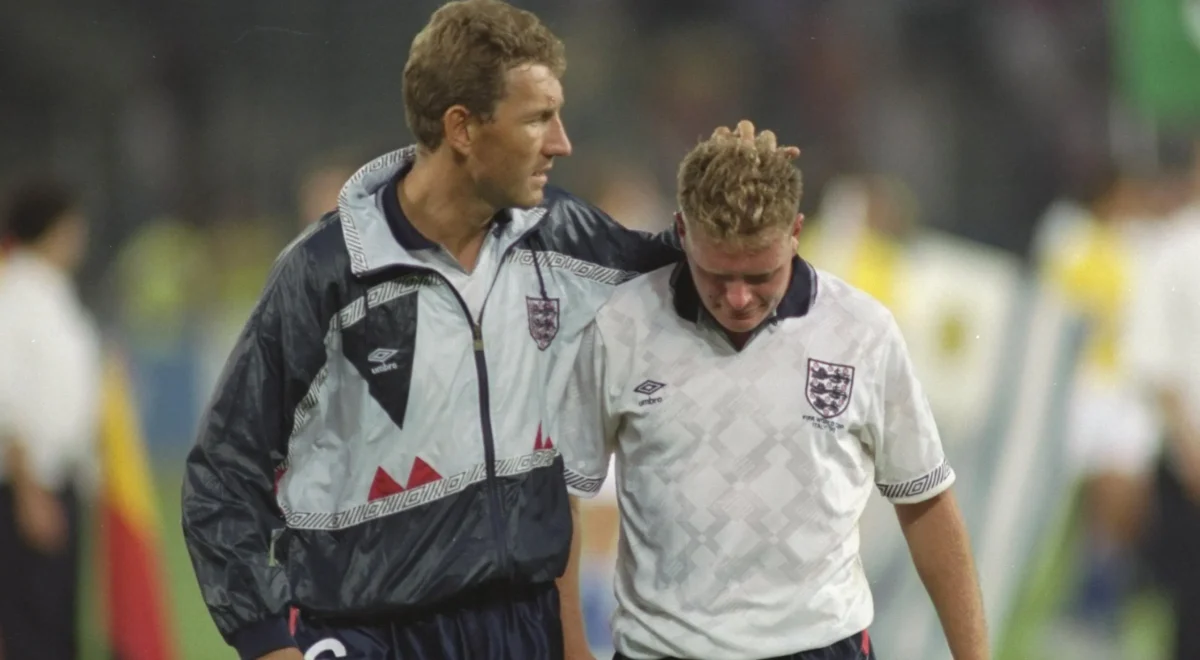
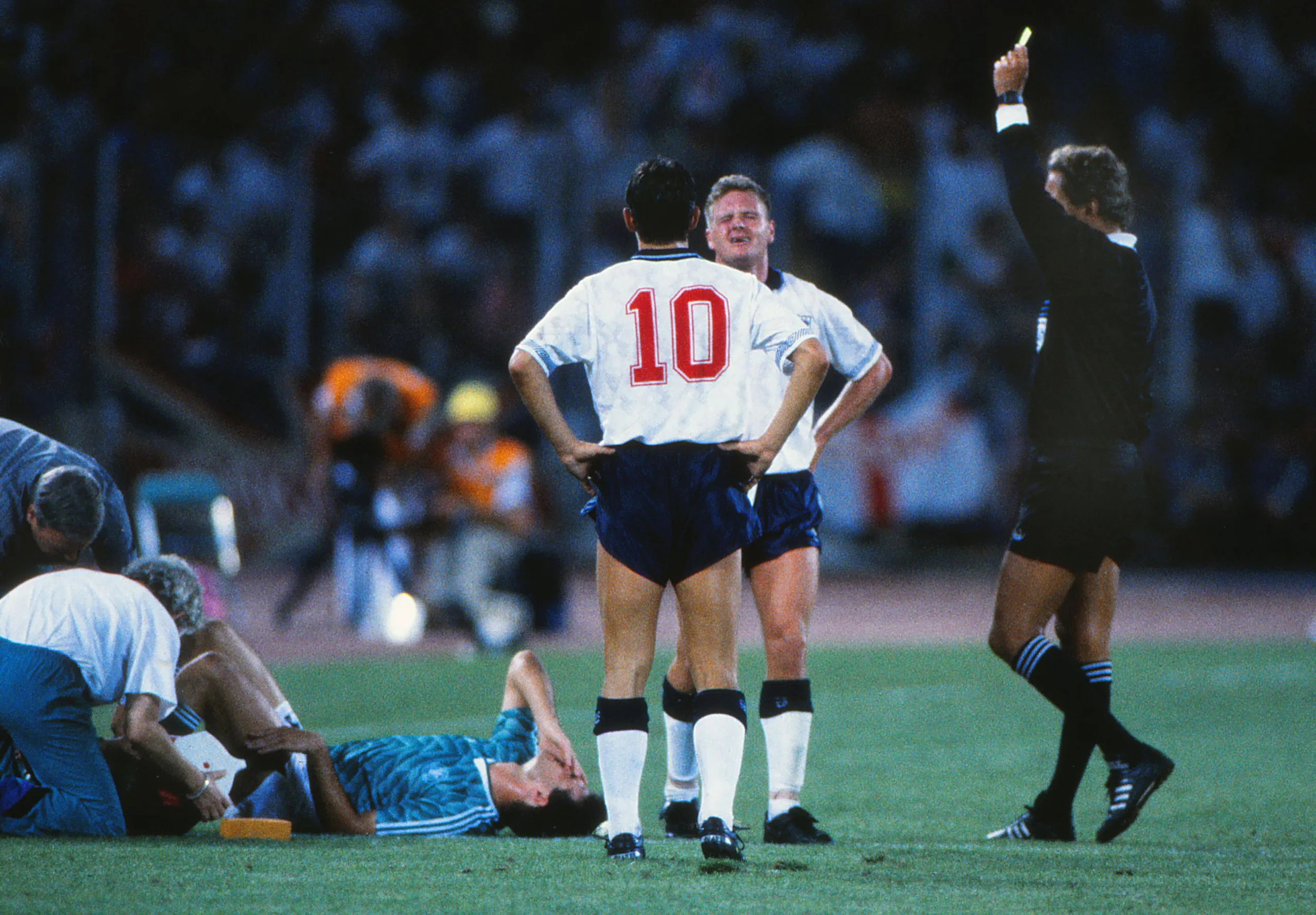
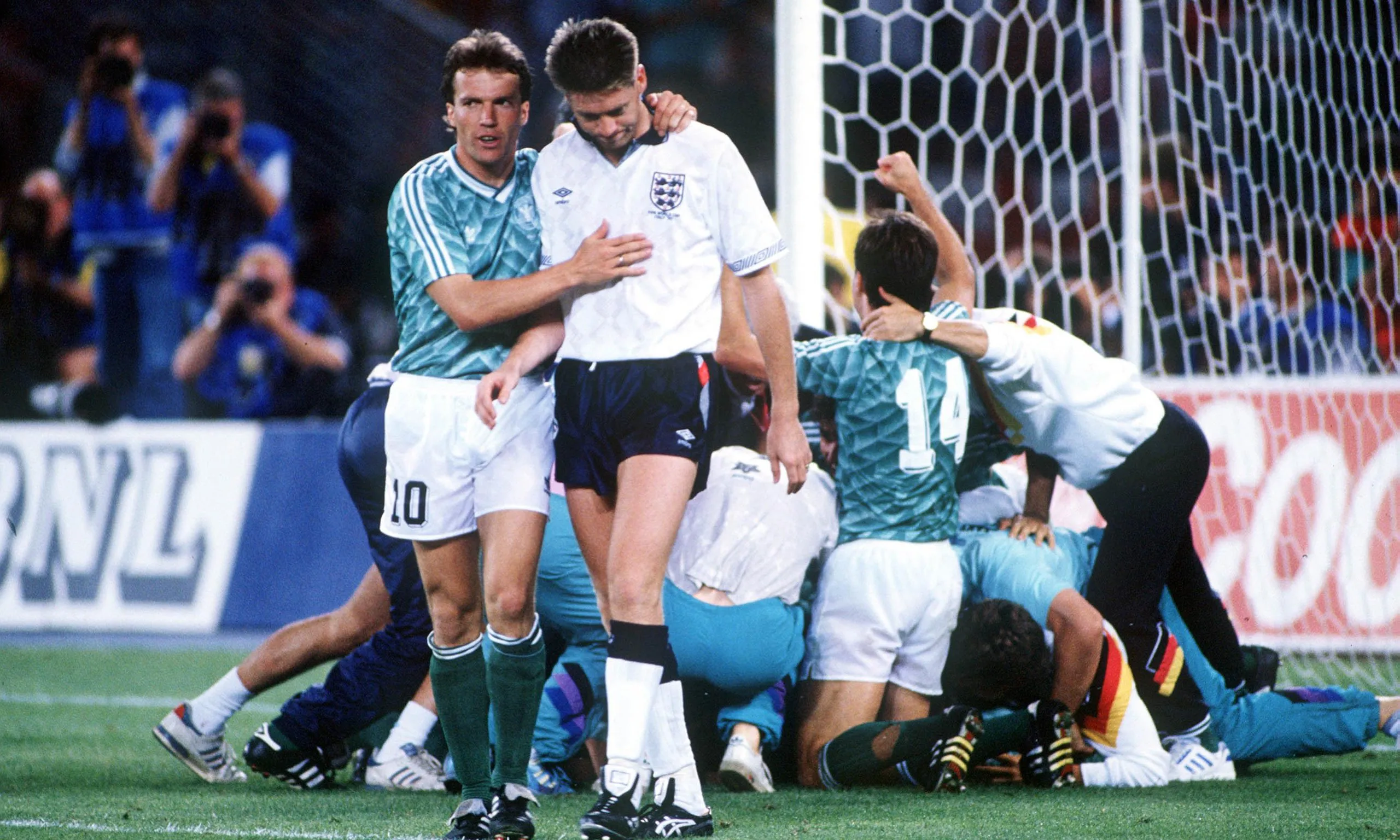
In a scene that resonated deeply with football enthusiasts, Paul Gascoigne’s emotions surged as England faced a devastating defeat in the semi-final of the Italia ’90 World Cup. Renowned for his lively spirit and exceptional skills, Gascoigne embodied a blend of tenacity and sadness as he reflected on the critical moment that led to his booking, ultimately preventing his participation in the final.
Looking back on the game, Gascoigne described the incident:
“I got the ball in the centre circle and bundled my way forward. Then, as Matthaus tried to nick it off me, I nudged the ball out of his reach, but overran it. I had to stretch as Thomas Berthold came across. I was giving it 110%. It was the World Cup semi-final and I didn’t want to give them anything for free. To this day I honestly don’t think I touched him, but down he went, rolling around as if in agony. I crouched down to make sure he was OK, and at that stage I wasn’t thinking I was in trouble. There was nothing in the challenge. Then everything turned to slow motion.”
Throughout England’s inspiring journey in the tournament, marked by David Platt’s goal against Belgium and Gary Lineker’s effort against West Germany, Gascoigne’s talent was on full display. However, the combination of his exceptional abilities and England’s ambitions culminated in heartache during this match.
Having previously started only one international match, Gascoigne’s memorable performance in a friendly against Czechoslovakia in April 1990 thrust him into the limelight. His development peaked during the semi-final against Germany, where he showcased his skills until the pivotal moment.
In his autobiography,Glorious: My World, Football and Me, Gascoigne elaborated on his feelings:
“I straightened up and turned to the ref,”
Bobby Robson, the manager of the national team, expressed his own despair regarding Gascoigne’s yellow card:
“He’s gone for his pocket. Suddenly I can’t hear anything. The world just stops apart from the bloke in black. My eyes follow his hand, to the pocket, then out with the card. There it is, raised above my head. I looked at the crowd, I looked at Lineker, and I couldn’t hold it back. At that moment I just wanted to be left alone. I didn’t want to talk to anyone or see anyone. My bottom lip was like a helicopter pad. I was devasted.”
As the yellow card was issued, Gascoigne’s expression transformed from fierce resolve to the sobering realization of his exclusion from the final. Robson noted,
“My heart sank the moment the referee took out the yellow card,”
Gary Lineker, another pivotal player, shared his thoughts on the lasting impact of that moment:
“My heart hit my shoes. Because I realised instantly, that was the final for Paul Gascoigne, out. And that’s a tragedy – for him, me, the team, the country, the whole of football. Because he was so good, and he was superb in this particular match. The bigger the game, the better he got. “Gascoigne knew as well, the moment the card was produced. Because I saw his face change, from being aggressive, fighting for the ball, to realising he’d committed an error, and he’d been booked, and he knew now the final was not for him. Tears began to well into his eyes. And Gary Lineker was very clever, he saw it immediately and came as close as he could to me and said, watch Gazza. Watch him. He thought now his mind might just go a bit berserk, even more berserk than he had with [giving away] the free kick. And I understood it. He knew the supreme penalty he was going to have to pay for that slight indiscretion.”
Robson suggested that the German players may have swayed the referee’s decision. He commented,
“Out of everything in my career, the moment people ask me about most often was when Gazza got booked in that semi-final,”
The referee, José Roberto Wright, later justified his ruling in a 2014 interview:
“I could see his bottom lip was going. I think it says a lot about Bobby that it was him I turned to, to ask him to have a word. I didn’t know that the moment would be caught on camera.”
Despite the contentious nature of the incident for England, Wright maintained his reputation as one of the tournament’s top referees. He recalled witnessing Gascoigne’s distress only after reviewing footage later:
“He flew in at the boy, upended everything, and the German bench all stood up, which unfortunately I think affected the referee,”
Gascoigne’s emotional breakdown struck a chord with both fans and players, forging a profound connection in that moment of collective sadness. Robson reassured him, urging Gascoigne to redirect his focus towards supporting his teammates.
“We don’t allow players to do that. We say, ‘Sit down, it’s got nothing to do with you.’ They all jumped up and it made it worse for Paul. It was only half a booking.”
Gascoigne’s response to the yellow card revealed deeper personal struggles, contrasting sharply with German player Michael Ballack’s reaction in later tournaments. Ballack, for instance, scored shortly after receiving a similar booking, demonstrating an entirely different mindset.
As the match progressed, Gascoigne’s emotional turmoil affected his performance, leading to Chris Waddle taking his place during the penalty shootout. Hamann commented on the weight of Gascoigne’s situation:
“Listen, there was no controversy,”
Although the team’s overall focus was on the game, much of the blame for the defeat fell on goalkeeper Peter Shilton, who faced backlash for his performance during the shootout. Pearce’s frustration was palpable when he exclaimed,
“The lad tackled an opponent from behind and nowadays he could even have been sent off. It was none of my business if Gascoigne already had a yellow card – my job was to apply the laws of the game. He tried to argue with me and apologise, but I told him in English that it was a bookable offence. Then I got on with the game.”
Gascoigne’s tears became a symbol of his career, leading to numerous endorsements and public appearances. In retrospect, Wright noted,
“I didn’t see him crying or all that commotion,”
In a subsequent interview, Gascoigne voiced his lingering resentment towards Berthold, revealing that the emotions from that fateful match still resonate:
“It wasn’t until later that I saw footage of the game and noticed how upset he was. Years later I read that Gascoigne’s tears were some kind of watershed moment in English football, that it helped people fall in love with the game once again.”
Even with the passing years, the memories of that match remain fresh. Gascoigne’s career path was irrevocably changed, and England’s quest for World Cup glory continued to slip away. Players and fans alike still reflect on that semi-final, where they came so close to triumph but ultimately fell short.
“I don’t know anybody who dislikes Paul Gascoigne,”
Gascoigne stated, echoing the sentiments of countless viewers of that match. The lingering echoes of that game continue to resonate as England seeks to reconcile its historical legacy with aspirations for the future.