

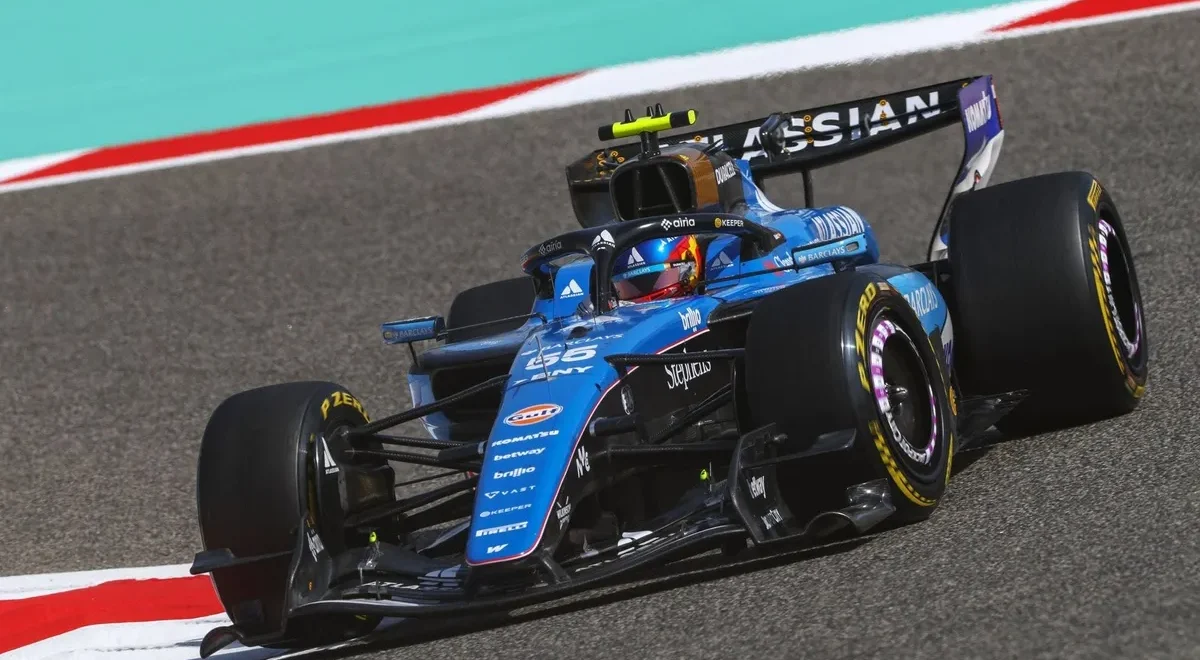
Williams racer Carlos Sainz has observed that Red Bull Ford’s power units seem to be distinctly ahead of the competition, reinforcing similar statements made by Mercedes. He provided valuable insights on maximizing performance with the upcoming 2026 generation of vehicles.
On Wednesday, Toto Wolff, the head of Mercedes, remarked that Red Bull Ford’s power units have set the standard during the winter tests in Bahrain, particularly highlighting the new manufacturer’s exceptional energy distribution from its electric motor.
Sainz, who competes for the Mercedes-affiliated Williams team, concurs with the assessment that Red Bull appears to have an advantage over other teams. He stated, “It’s still very early in the season, but judging by yesterday’s GPS data, it’s evident that Red Bull Ford Powertrains were performing at a level above the rest. Their progress is not just marginal; it’s quite significant and impressive.”
The Spanish driver continued, “If they arrive at the first race with a completely new set of rules, an entirely new engine, and a fresh team, yet are able to establish themselves as the fastest and most reliable, we must acknowledge their achievement. What they demonstrated yesterday was indeed remarkable.”
Data from GPS technology supports the praise from the Mercedes camp, as Max Verstappen, during his longer runs, effectively recharged his battery. This allowed him to utilize the full capacity of 350kW on the straights, consistently reaching higher speeds than his rivals.
However, Sainz cautions that the typical uncertainties of differing testing strategies and potential deception during winter sessions may complicate the interpretation of these findings. Teams still have five days of testing ahead to finalize their power unit strategies, which have become crucial under the new 2026 regulations.
This also appears to be a timely moment for teams powered by Mercedes to highlight Red Bull-Ford’s purported edge with its new hybrid systems, particularly as competitors work to challenge Mercedes’ interpretation of engine compression regulations.
The energy produced by the electric motor has increased threefold compared to the previous generation, now contributing up to half of the total power output. Nevertheless, the battery capacity remains unchanged, which means drivers could quickly exhaust their energy reserves multiple times during a lap.
As a result, during the Bahrain tests, drivers resorted to lower gears in slower corners to maintain revs and maximize energy recovery whenever feasible. While some of this is attributed to driving techniques, the power unit’s software is designed to adapt based on previous laps to enhance energy harvesting and deployment efficiency.
Sainz emphasized that refining energy harvesting methods without compromising cornering performance will be essential for unlocking overall speed. He noted, “The essence of these regulations lies in not separating the power unit from cornering dynamics but in integrating them seamlessly.”
He elaborated, “From my observations yesterday, it appears that Red Bull has successfully accomplished this without forcing drivers into compromises. When the car indicates a need to downshift a certain way, you simply follow its guidance. That’s why, after completing around 300 to 400 laps in Bahrain, all drivers are focused on refining various techniques to improve the car’s driveability and performance.”
Finally, Sainz concluded, “The integration of the power unit, gearbox, and driver preferences must form a cohesive system. If any component does not meet the driver’s expectations, challenges will arise. Therefore, every team must adapt and discover the optimal approach.”