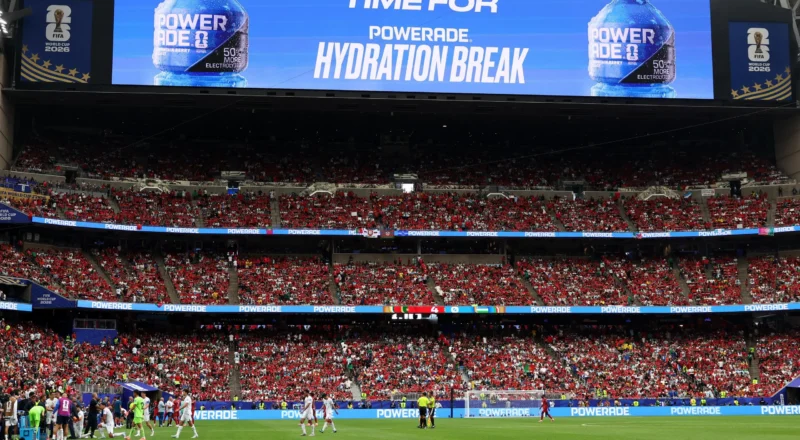



Throughout the World Cup, viewers likely noticed prominent advertisements proclaiming Aramco as the tournament’s “energy partner.” This Saudi Arabian oil giant stands as the largest corporate contributor to global pollution, while Saudi Arabia has consistently hindered advancements in international climate change discussions. The involvement of Aramco is a significant facet of FIFA’s ongoing sportswashing efforts, causing discontent among fans worldwide.
The uneasy alliance between contemporary football and polluting industries has deep historical roots that can be delineated into three distinct eras. Initially, football emerged in British society as a means to regulate and control the working class, eventually evolving into a cultural export of the British Empire and capitalism. The Factory Act of 1850 granted workers the right to have Saturday afternoons off starting at 2 PM, which explains the traditional kick-off time of 3 PM.
As European industrialism, militarism, and colonialism spread football around the globe, industrialization in Britain laid the groundwork for organized competitions necessitating order, discipline, and structure. The sport migrated from England and Scotland to industrial regions in northeast France, northwest Germany, and various ports in France, Italy, Portugal, Spain, Argentina, Uruguay, and Brazil.
The postwar era marked a transformation as football became professionalized, increasingly ruled by clubs situated in industrial cities. Many of these clubs had strong ties to the automotive sector, with notable examples being Juventus’s association with Fiat and Wolfsburg’s connection to Volkswagen. The economic frameworks governing football during this time resulted in a more equitable distribution of elite men’s football compared to the present.
After the early supremacy of clubs like Real Madrid, Milan, Inter, and Benfica, a phase of “Eurosclerosis” ensued, characterized by declining playing standards and European Cup finals featuring smaller clubs from less prominent cities, such as Malmö.
This newfound parity posed a challenge to major clubs, prompting them to advocate for adjustments to competition structures and increased influence within their leagues, particularly in England, Italy, and Spain.
With the launch of the Champions League and the Premier League in the early 1990s, football underwent significant globalization. This shift facilitated investments from fossil capital, primarily benefiting the most prestigious clubs in the most appealing locales.
The 1990s saw nine different European clubs crowned champions from nine various cities; however, only three clubs have won the Champions League without being part of the 14 leading clubs that pushed for its expansion in the late 1990s. These clubs—Chelsea, Manchester City, and Paris Saint-Germain—secured their elite status through petrodollar investments from wealthy backers: Roman Abramovich, Sheikh Mansour from the UAE royal family, and Qatar Sports Investments, respectively. Meanwhile, for those unable to keep pace, bankruptcy has become increasingly prevalent.
Currently, the only avenue for a club to ascend to elite status in European men’s football is through investment from a petrostate, which further entrenches the sport’s carbon footprint and embeds fossil fuels into the very fabric of its culture. Despite a growing awareness that fossil fuels contribute to climate change and pose a threat to civilization, fossil capital remains powerful.
To rationalize the postponement of a green transition, fossil fuel companies strive to position themselves as a necessary evil, so ingrained in our lives that it’s hard to envision a fulfilling existence without them. This is where sportswashing becomes relevant, with football—and FIFA—playing a critical role.
Every time a petrostate or oil tycoon acquires a football club, sponsors an event, or places their logo on the jerseys of beloved players, the grip of fossil capital tightens, making it increasingly difficult to envision the sport or the world devoid of its influence.
As we cherish the beautiful game, we often accept the uncomfortable reality of fossil capital’s role in sustaining it. Aramco’s involvement in the World Cup serves to propagate the notion that we have no alternative but to continue relying on fossil fuels. We must resist this narrative.
Oscar Berglund serves as a senior lecturer in international public and social policy at the University of Bristol and is a co-author of the report “Football and Climate Change: A Preview of the 2026 FIFA World Cup.”