

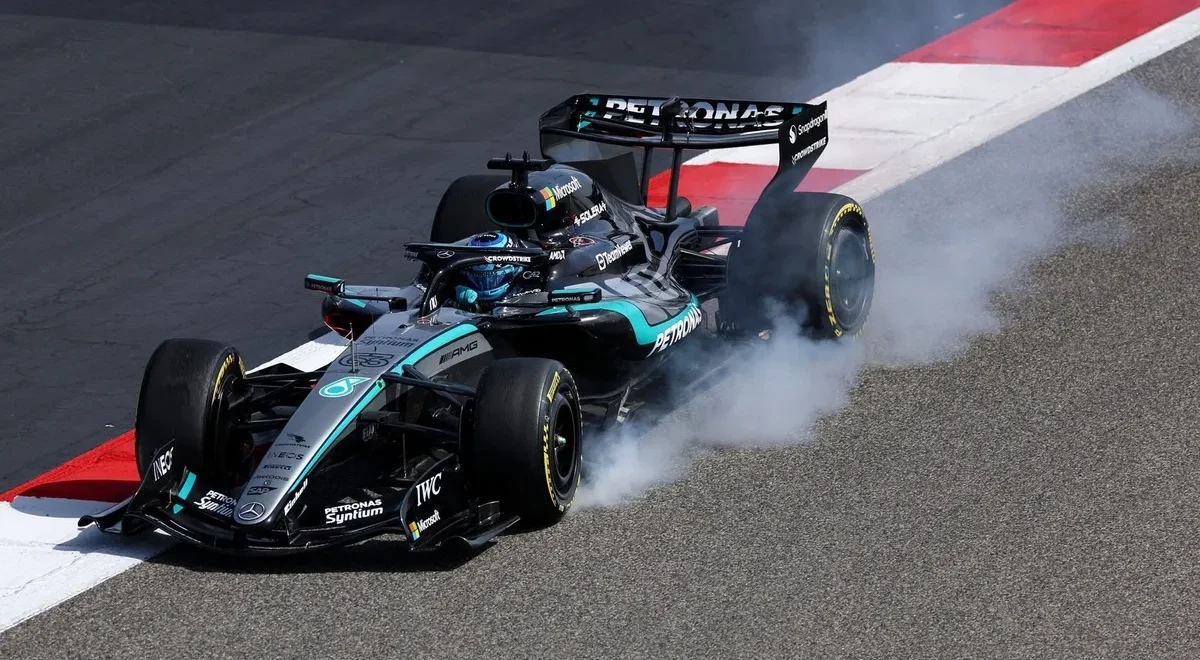
The Mercedes engine has become a focal point as Formula 1 testing kicks off in Bahrain. Despite Toto Wolff’s assertion that Red Bull sets the standard, the reality remains that competitors are actively seeking adjustments to the compression ratio checks ahead of the season’s commencement.
Teams are pressuring the FIA to revise the protocols, given that Mercedes adheres to the 16:1 ratio during static tests at ambient temperature, yet can achieve a higher ratio during actual track performance. Wolff, sharing the sentiment of Williams team principal James Vowles, insists that all Mercedes engines comply with regulations, although he is no longer dismissive of potential interventions.
“I’m a little bit more confused in the recent weeks about how it came to the point now that it suddenly became a topic, because until last Friday, I was given the impression that things wouldn’t change,”
Wolff remarked. When asked if he sensed an impending FIA intervention since last Friday, he mentioned, “Well, I read an article from an Italian website that said things are going to change, so I thought that we should know!” This comment, albeit made lightheartedly, carried a serious undertone in Wolff’s address in Bahrain.
The tone in Bahrain contrasted with his previous comments during the Mercedes launch, where he had urged other manufacturers to “get their act together.” This time, he acknowledged that Mercedes would face significant challenges if competitors united against them.
“It’s not only the teams, you need the votes from the governing body, and you need the votes from the commercial rights holder, and if they decided to share an opinion and an agenda, then you’re screwed.”
Wolff expressed concern over the increased lobbying efforts by rival engine manufacturers in recent months. He noted that clandestine meetings and communications with the FIA have become commonplace, leading to the current situation.
For any intervention to take place, a supermajority in the Power Unit Advisory Committee is necessary, which includes four out of five engine manufacturers, along with the FIA and FOM. The decision now lies with the FIA, and Wolff is no longer ruling out any possible scenario.
“You know, in this sport, it’s full of surprises, so there is never a situation where you can say you’re sure about anything,”
he explained. Wolff continued, emphasizing that throughout the engine design process, Mercedes closely engaged with the FIA, receiving assurances that their actions conformed to the rules. He pointed out that the discussion is not about a substantial performance advantage, but more about the grievances of competitors lobbying the FIA.
A crucial question arises regarding the participation of Mercedes-powered teams in the Australian Grand Prix if the FIA alters measurement procedures, such as assessing a hot engine or utilizing sensors during operation. With the homologation date for all 2026 engines set for March 1, there is little time for modifications, particularly concerning fundamental components.
“Well, if it becomes a regulation, you need to adhere to the regulation,”
Wolff stated. He added that if compliance is not feasible, the FIA would need to devise some form of adjustment, which remains ambiguous at this point. He cautioned that altering engine operation methods could significantly impact performance.
Nevertheless, Wolff dismissed speculation that Mercedes would pursue legal action in such an event.
“There is no such scenario as we would sue anyone,”
he asserted. In his view, it is vital to have clarity regarding the rules in Formula 1, while also respecting engineering innovation. He reiterated that if the sport’s governance decides to amend the rules, regardless of their impact on Mercedes, the team must adapt.
As he wrapped up his comments, Wolff emphasized that the compression ratio is not a critical performance differentiator, dismissing claims of 10 to 13 horsepower advantages as exaggerated. “It’s just a few horsepower. In England, you would say a couple, which is more like two and three,” he noted. He stressed the minimal effect on grand prix outcomes, focusing instead on the implications of setting new precedents and the challenges of implementing new regulations.
Wolff warned that after six races, anyone believing they could catch up might start examining compression ratios and revamping their engines, given the potential for changes in regulations.