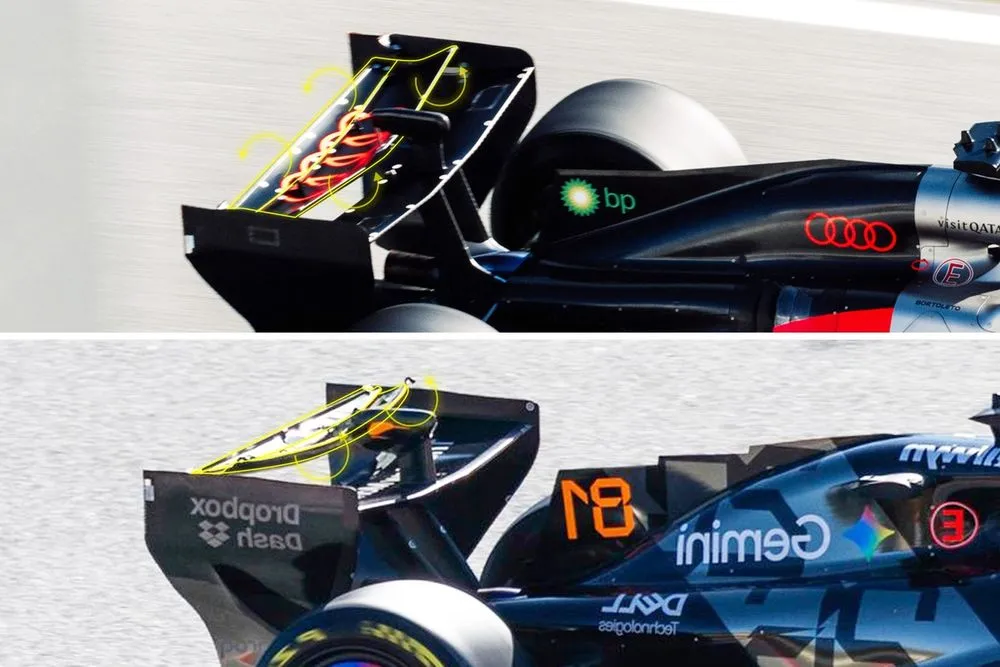


During the recent showcase in Barcelona, various teams presented their interpretations of Formula 1’s revamped active aerodynamics, with Audi and Alpine notably distinguishing themselves through their unique rear wing designs. Audi’s strategy involves positioning the rotation pivot at the center of the rear flaps rather than at the leading or trailing edges, resulting in a distinct rotational movement compared to their competitors.
This year marks a pivotal transformation in F1 regulations, especially concerning active aerodynamics. The shift goes beyond the traditional Drag Reduction System (DRS), as now adjustable components will feature on both the front and rear wings, allowing teams to utilize them on every straight section of the track, irrespective of their racing position.
The regulations set for 2026, while still adhering to FIA guidelines, are encouraging engineers to unleash their creativity, leading to an array of design philosophies visible throughout the F1 field. This creative freedom is particularly evident in the diverse active aerodynamic designs undertaken by different teams.
Teams across the grid are experimenting with various geometries for movable flaps, with differences in the number of wing elements that can be adjusted. Some teams might even adapt their solutions from one race to another based on specific circuit characteristics. Notably, there is considerable variation in how teams operate their rear wings.
Previously, teams faced strict limitations, utilizing the maximum 85-millimeter opening permitted by the rules, which involved raising the leading edge through an actuator while fixing the trailing edge in place.
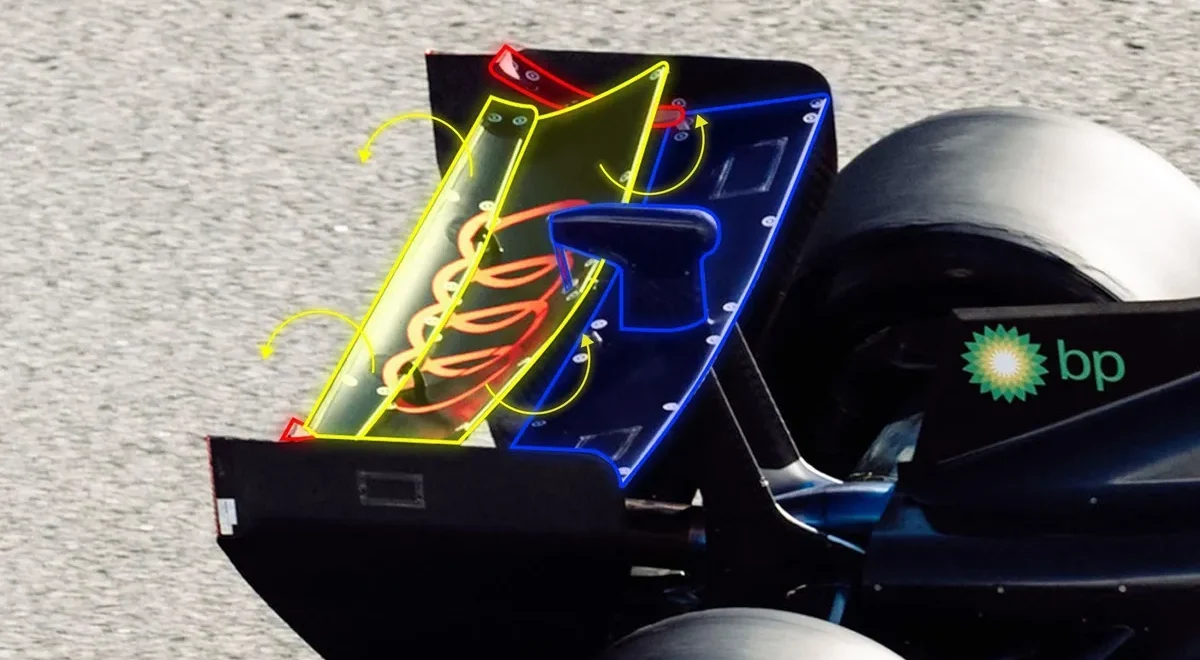
In contrast, Audi’s rear wing features two mobile flaps that operate in a novel manner. The pivotal rotation point, which used to be located at the back of the movable flap, has now shifted, allowing for an upward lift of the front section instead of the rear.
While most teams have retained traditional mechanisms where the leading edge rises and the trailing edge stays fixed—often elevating above the outer endplate to enhance airflow and minimize drag—Audi and Alpine have opted for a different approach. In Alpine’s variant, the design operates inversely, collapsing the trailing edge while keeping the leading edge intact, effectively extending the mainplane.
Audi’s innovation is particularly intriguing, as their engineers have adopted a hybrid solution that diverges from both extremes. They have placed the pivot point for the rotation of the rear flaps precisely at the center of their lateral supports, which comply with regulatory requirements.
This unique configuration means that the flaps on the Audi R26 no longer sit nearly flat or at a slight angle; instead, they adopt a more pronounced incline when opened, resulting in a smaller gap in comparison to rival designs.
This unconventional setup not only alters the angle of the flaps but also influences the airflow direction around that section of the vehicle. The aerodynamic result is a downward push of air, a consequence of the steep angle assumed by the flaps during their activation.
Many teams employ two actuators—one for each moving flap—to raise them simultaneously. However, Audi has implemented a distinctive mechanism: a single linkage operates the first flap, while the second flap moves passively, guided by small supports that connect the two profiles rather than being directly driven by the actuator, as seen in other teams’ designs.