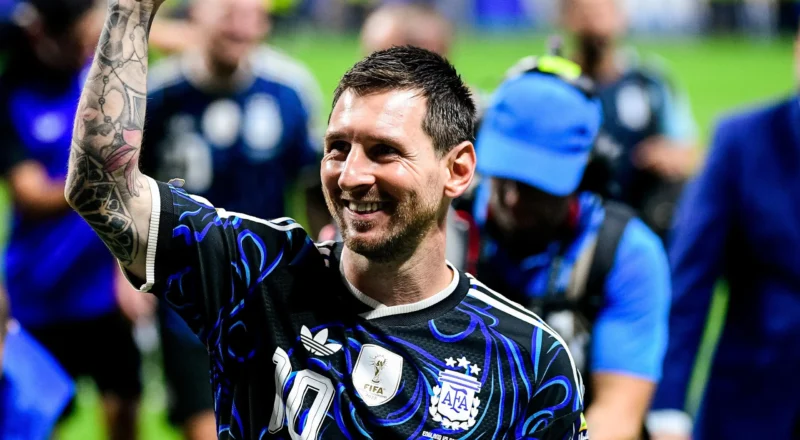


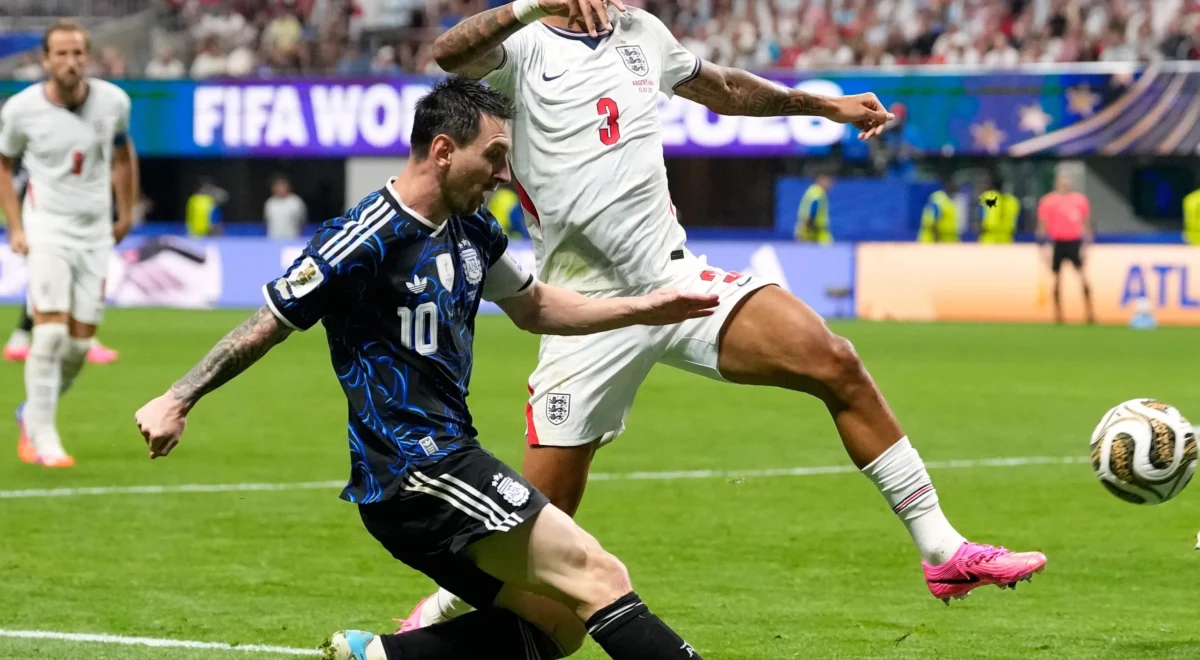
Before the match between England and Argentina, Thomas Tuchel likely considered every possible scenario his team might face. He would have strategized on how to maintain a strong defense while finding ways to exploit Argentina’s weaknesses in attack. Additionally, like many managers before him, he would have dedicated considerable thought to containing Lionel Messi.
Initially, Messi was largely uninvolved, as statistics revealed that England effectively curtailed his impact in critical areas. His only touch inside the penalty area was thwarted by a tackle from Elliot Anderson, shortly after Anthony Gordon’s goal. The portion of the distance he sprinted, defined by Fifa as traveling at least 20 km/h, was a mere 4.3%, lower than his sprint rates against Switzerland (4.6%) and Egypt (5.4%) in the previous matches.
For Tuchel, Messi’s limited number of shots would have been reassuring. The Argentine icon managed only one long-range attempt, which was blocked before it reached England’s goal. In fact, only once before in his 19 World Cup matches where he played the full 90 minutes had he registered so few shots during regular time, although he did play 120 minutes in a match against the Netherlands in 2014 with just one shot on target. In the 2018 tournament, his only shot against Croatia was from very close range, making this performance one of the weakest displays he has shown in this competition.
Messi’s Subtle Shift in Play
Messi’s heat map indicated that he had drifted into familiar territory, primarily in the right half-space near the opponent’s penalty area. While it would be inaccurate to say England had him exactly where they wanted, they at least managed to anticipate his positioning. Such predictability can be crucial in formulating defensive strategies.
However, a full match heat map can obscure the nuanced shifts that take place throughout the game. For instance, Messi’s only touch in the zone between the penalty box and the touchline during the first half came near the center circle, where he made a forward pass to Giuliano Simeone, who was offside.
Game-Changing Crosses
Yet it was from this very flank that Messi began to turn the tide in Argentina’s favor. In the second half, he launched six open-play crosses from this area. This figure is extraordinarily high for a player who has averaged just 2.3 crosses (including set pieces) per 90 minutes in league play since 2015. Notably, he had only attempted more crosses in two World Cup matches prior to this one, both of which were in earlier rounds.
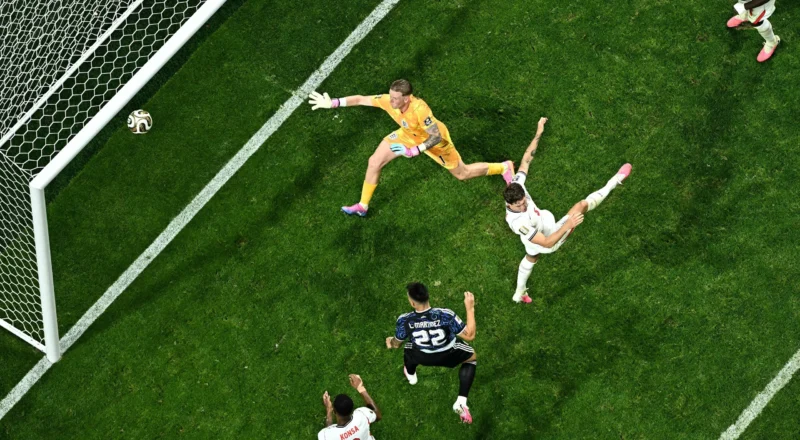
One of his crosses nearly resulted in a goal when Nico González’s header was expertly saved by Jordan Pickford, shortly before the second hydration break. This moment likely influenced Tuchel’s decision to introduce Ezri Konsa immediately afterward, later reinforcing the back line with Dan Burn after switching to a five-man defense. This tactic had proven effective against Mexico, so Tuchel may have felt it was worth trying again.
Messi’s Impact on the Game
However, Messi’s crossing ability far surpasses that of Roberto Alvarado and Jesús Gallardo, who had combined to attempt 25 open-play crosses against Mexico, yielding only one chance valued at 0.05 xG. In contrast, Messi’s cross that set up Lautaro Martínez’s winning goal generated 0.53 xG, which was greater than all of England’s chances combined throughout the match. This assist marked only his second World Cup assist with his right foot, and it proved significantly more challenging than the cutback he delivered to Julián Álvarez in the semi-finals in Qatar.
It was a statistically unusual match for Messi, filled with anomalies, yet it made no difference. Wherever there is space, the greatest player of all time will inevitably find a way to disrupt even the most meticulously crafted plans.