


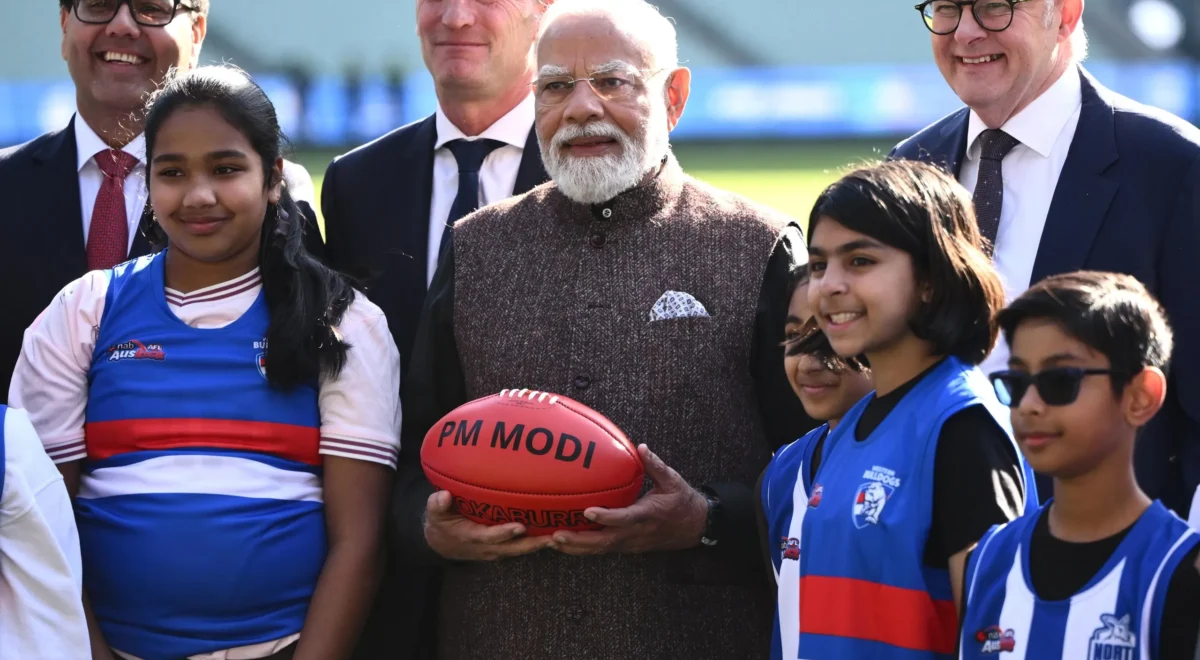

The AFL is embarking on a new initiative aimed at establishing a stronger foothold in India, driven by optimism but not devoid of risks. The league’s chief, Andrew Dillon, unveiled a long-term strategy during a joint announcement with Prime Minister Anthony Albanese and India’s Prime Minister Narendra Modi, emphasizing the importance of enhancing bilateral relations while promoting the sport.
The AFL has set an ambitious target of securing over 100,000 registered players in India within the next few years. This goal comes as the league takes over the grassroots efforts previously led by local volunteers and community advocates who have worked to grow the sport since its introduction in 2008. Currently, more than 20,000 individuals have engaged with Australian rules football, highlighting significant potential for expansion in the world’s most populous nation.
This comprehensive strategy focuses on bolstering junior and grassroots involvement through educational institutions, training programs for coaches and umpires, and the creation of an AFL India talent academy. The plan also aims to enhance national competitions and pathways for representation, in addition to promoting participation among women and girls. The AFL plans to distribute tens of thousands of Sherrin footballs and other resources to local communities, aspiring to make Australian rules football accessible in every Indian state and school.
The AFL’s approach this time may differ from previous attempts, as it seeks to develop the sport organically rather than merely staging elite matches in unfamiliar territories. A shared passion for sports between India and Australia may serve as an advantage, given that Australian rules football was initially created over 160 years ago to help cricketers stay fit during the off-season. While cricket fields in India often do not accommodate other sports, the setting for the announcement at the Melbourne Cricket Ground is significant.
As the AFL explores this expansion, it has also initiated efforts to connect with Australia’s rapidly growing Indian diaspora. Initiatives such as Hindi broadcasts of AFL games, AFL Khel digital media channels, and cultural heritage projects aim to engage the community. With approximately 27.6 million people in Australia, including 971,020 born in India, the league recognizes the potential to tap into this demographic, which is the largest overseas-born group in the country.
However, despite the increase in the Indian-born population from 449,040 in 2015, Australian rules football has not seen a corresponding rise in participation at the local level. Some regions in the AFL’s traditional strongholds are witnessing a decline in local football clubs, with cricket becoming increasingly dominant. This trend underscores the need for the AFL to adapt and effectively reach new communities.
The league is still awaiting its first player with both parents of Indian heritage to compete at the top level. Jai Saxena, who joined Collingwood as a rookie last year, is only the second player with dual Indian heritage on an AFL list, while Balraj Singh, drafted by Adelaide in 1999, did not play a senior game. Daniel Kerr stands out as the most notable player with Indian roots, alongside others like Ben McNiece, Alex Morgan, and Blaine Boekhorst in the AFL, and Zoe Savarirayan in the AFLW.
The Western Bulldogs have expressed interest in being one of the first clubs to play a competitive match in India, should the AFL decide to deepen its commitment to the region. For now, the league is rightly focusing on investing both domestically and internationally as it seeks to identify the next wave of pioneers who will reshape the game’s future.
- AFL
- Australian rules football
- Australia sport
- analysis